304 and 316L stainless steel jewelry can look identical on display. It’s important that you know the differences between 304 vs. 316L stainless jewelry to select the more suitable one for your brand.
Why 304 and 316L are the Gold Standard for Steel Jewelry
304 and 316L are two of the most popular steels in modern jewelry production. These stainless steels have gained dominance in both fast-fashion and premium jewelry lines because of their balance of longevity, safety, and economical value.

304 and 316L are extremely durable, which is very essential in the jewelry industry where product longevity directly impacts your brand credibility and customer retention. They are resistant to rust, oxidation, and surface degradation, ensuring that the jewelry maintains its structural integrity and visual appeal.
Also, both of them are generally stable and less likely to cause skin irritation. 304 and 316L stainless steel are safe to wear for a long period without causing adverse reactions—particularly on people with sensitive skin.
In addition, they are quite affordable when compared with other durable, hypoallergenic materials like gold and silver.
Technical Breakdown: Comparing Composition and MOQs
Understanding 304 (Food Grade) vs. 316L (Surgical Grade)
To really understand 304 and 316L stainless steel, you must know their chemical composition differences.
304 stainless steel contains a large percentage of iron, 18-20% chromium, and 8-10.5% nickel. This composition delivers strong resistance to corrosion and oxidation, making it suitable for general-purpose jewelry that can withstand everyday conditions like moisture and air. However, it contains a higher level of carbon compared to 316L, which makes it vulnerable to extreme conditions like prolonged exposure to sweat, chlorinated water, saltwater, or chemicals.
316L, on the other hand, contains a large percentage of iron, 16-18% chromium, 10-14% nickel, 2-3% molybdenum, and a lower carbon content (which is what L stands for). The addition of molybdenum increases its resistance to chlorides & extreme conditions like intense sweat, chlorinated water, saltwater, and chemicals. More importantly, its low carbon content reduces the risk of internal corrosion.
These compositional differences impact their sourcing and MOQs for production. 304 stainless steel is more widely available and easier to process, which allows manufacturers to offer lower minimum order quantities (MOQs).
In contrast, 316L requires tougher processing and higher raw material costs. As a result, manufacturers often impose higher MOQs to maintain production efficiency.
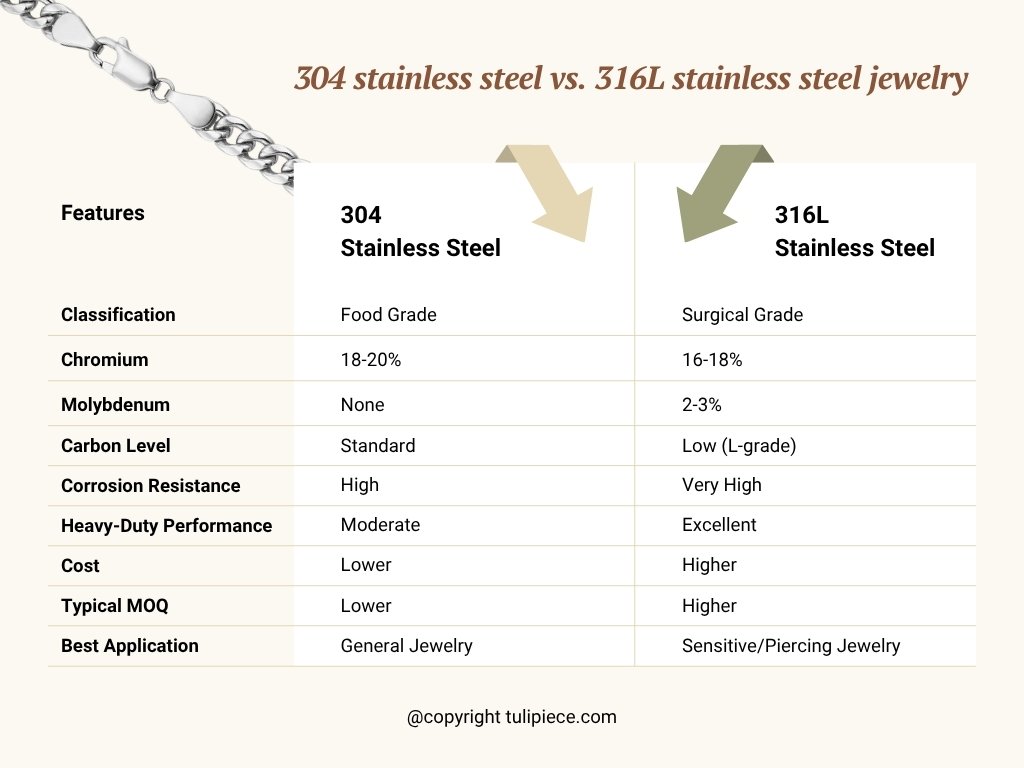
| Features | 304 Stainless Steel | 316L Stainless Steel |
| Classification | Food Grade | Surgical Grade |
| Chromium | 18-20% | 16-18% |
| Nickel | 8-10.5% | 10-14% |
| Molybdenum | None | 2-3% |
| Carbon Level | Standard | Low (L-grade) |
| Corrosion Resistance | High | Very High |
| Resistance to Extreme Conditions | Moderate | Excellent |
| Cost | Lower | Higher |
| Typical MOQ | Lower | Higher |
| Best Application | General Jewelry | Sensitive/Piercing Jewelry |
Download the comparison chart
Performance Review: Is 316L Always the Better Choice?
316L stainless steel is often referred to as the higher-grade option, but that doesn’t automatically make it the best choice for every jewelry application. In practice, the better choice depends on how and where the jewelry will be worn.
304 Stainless Steel Performance
For standard fashion jewelry, such as necklaces, bracelets, and rings, 304 stainless steel is a reliable option. It offers solid resistance to tarnishing and maintains its finish under normal daily use.

Pros
- Cost-efficient for high-volume production
- Easier sourcing with lower MOQs
- Reliable durability for everyday use
Cons
- Less optimal for prolonged moisture exposure
- Lower resistance to chlorides and harsh conditions
- Not 100% suitable for individuals with sensitive skin
316L Stainless Steel Performance
316L stainless steel is a better option in conditions where prolonged skin contact is unavoidable, such as custom earrings, piercings, and other body jewelry. Its enhanced resistance to moisture, sweat, and chemicals makes it a safe option for delicate conditions.
Pros
- Superior corrosion and tarnish resistance
- Performs well in harsh or humid environments
- Excellent for sensitive skin and medical-style use
Cons
- Higher material and production costs
- Typically requires larger MOQs
Strategic Sourcing: Which Grade Fits Your Product Line?
Choosing between 304 and 316L stainless steel should be a deliberate business decision. Each grade is best suited for specific purposes.
Choose 304 stainless steel if:
- You produce everyday fashion jewelry like necklaces, bracelets, and rings
- Your target customers are price-sensitive and prefer affordable options
- You need lower MOQs to test designs or scale your business quickly
Choose 316L stainless steel if:
- You manufacture body jewelry, piercings, or pieces with prolonged skin contact
- Your target markets are concerned about skin sensitivity and comfort
- You want to reduce long-term issues like corrosion, discoloration, or complaints
Many brands use both grades strategically: 304 for cost-efficient, trend-driven pieces and 316L for luxury or hypoallergenic collections. This approach allows you to balance cost, durability, safety, and brand perception without overcommitting to one grade.
Conclusion: Making the Right Investment
When you have to choose between 304 vs. 316L stainless steel jewelry, there are 3 major factors to consider: your target market, how much money you’re willing to spend, and your brand’s position. Also, it’s advisable to always work with a professional custom jewelry manufacturer who can seamlessly align any material of your choice with your business goals.