
Many jewelry brands reach a stage where growth feels stuck. Sales may exist, but they’re unstable. Orders come in, yet margins are too thin to scale. Expansion, in this context, is not simply about selling more—it’s about breaking through structural limits. From working with jewelry brands at different growth stages, one pattern is clear: the fastest way to grow a jewelry brand rarely comes from launching more products—it comes from fixing the right structural issues in the right order.
You Might Feel Stuck at This Stage for Your Jewelry Business
Before you can implement best practices to scale a jewelry brand, you must identify where the friction lies. Most jewelry brands—from e-commerce startups to established retailers—encounter three primary bottlenecks.
- Sales volume is too small or inconsistent
You may have demand, but without steady order flow, it’s difficult to forecast, plan inventory, or invest confidently in growth.
- Orders exist, but margins are too thin to scale
Products sell, yet profit per order isn’t enough to support marketing, team expansion, or larger production runs.
- Growth hits a ceiling due to unstable quality and limited production capacity
Unstable quality, delivery delays, or limited jewelry manufacturing ability and capacity quietly block your brand from taking on larger or repeat orders.
These challenges block sustainable scaling. Addressing them strategically is the foundation for how to grow a jewelry business fast and achieve long-term success.
Analyze and Diagnose the Real Problems Before the Next Step
Before trying to expand, brands need to identify why expansion feels necessary. These drivers usually fall into four core areas.
#1: Jewelry Design Misalignment With the Market
Your designs may be visually strong, but do they align with real demand? Evaluate whether your current pieces are:
- Too niche to reach a scalable audience
- Overly trend-driven with short lifecycles
- Misaligned with everyday wearing habits
Designs without longevity reduce repeat purchases and push brands toward constant promotions—raising marketing costs and slowing sustainable expansion. At this stage, many brands benefit from jewelry design support from manufacturers to balance creativity with market fit.
#2: Jewelry Material Choices That Limit Growth
Jewelry material decisions directly affect pricing, margins, and scalability. Review whether:
- Material costs exceed what your target audience can sustain
- Material durability supports daily wear and lifestyle positioning
When jewelry materials don’t match your growth stage, brands struggle to scale profitably and remain flexible. For brands considering a change, our guide What If I Want to Switch Metal for My Jewelry Line (what to know) explains key factors to consider before making material changes.
#3: Slow or Inefficient Product Development Cycles
Random or rushed launches weaken brand momentum instead of building it. Evaluate your product release rhythm:
- Are launches too slow to keep attention?
- Too infrequent to stay relevant?
- Too risky, with high upfront investment?
Without a steady and manageable release rhythm, visibility drops and expansion loses direction.
#4: Quality Problems That Block Scaling
As volume increases, quality issues multiply. Assess whether you face:
- Inconsistent batch quality or unstable electroplating
- Allergy risks, whether in accordance with hypoallergenic jewelry
- Compliance gaps with standards like the EU Nickel Directive or sustainability
Without strict jewelry quality control and compliance, entering wholesale or high-volume channels becomes extremely difficult.
From “Guessing” to “Evidence-Based” Jewelry Brand Expansion
To scale effectively, you must move from intuition to data-driven decision-making. Before expanding, brands that scale well usually do two things consistently.
Listen to the Market
Direct customer feedback is your best R&D tool. Analyze:
- Reviews: Identify repeated complaints, fit issues, or unmet expectations
- Post-purchase surveys: Understand why customers buy—and why they hesitate
- DMs & emails: Spot early demand for new styles, materials, or price points
Clear patterns in feedback reveal where to improve, what to scale, and what to stop.
Study Competitors Strategically
Competitor analysis isn’t about copying—it’s about finding gaps and positioning opportunities. Review their:
- Material choices: What materials they use? What supports daily wear and long-term use?
- Price positioning: Where are they premium, mid-range, or accessible?
- Release frequency: How often do they introduce new collections?
Smart benchmarking helps you avoid overcrowded spaces and expand with intention, not guesswork.
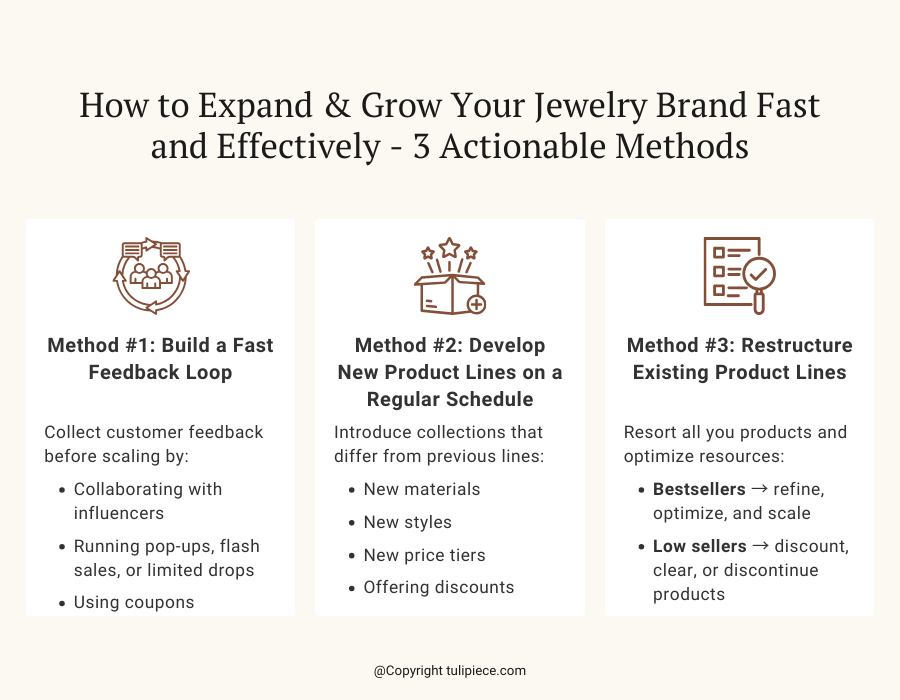
How to Expand & Grow Your Jewelry Brand Fast and Effectively – 3 Actionable Methods
Once the diagnosis is complete, use these three methods to accelerate your brand’s trajectory.
Method #1: Build a Fast Feedback Loop
Test ideas before scaling by:
- Using coupons and collaborating with small to medium influencers or micro-creators to gauge audience interest.
- Running pop-ups, flash sales, or “Limited Drops” to test and see which designs sell out first.
These approaches reduce inventory risk and show what truly drives sales, an essential step in learning how to grow a jewelry brand and increase jewelry sales. Meanwhile, you can consult an experienced manufacturer like Tulipiece, who can provide jewelry consulting on market trends, material choices, and practical business strategies.
Method #2: Develop New Product Lines on a Regular, Controlled Schedule
Instead of launching new products randomly, set a planned and consistent product development cycle. This means:
- Schedule releases in a predictable rhythm—monthly, quarterly, or seasonally—so your team can plan marketing, inventory, and production efficiently.
- Focus on introducing collections with new materials, styles, or price tiers while ensuring each release is thoughtfully tested.
Expansion succeeds when new products are strategic experiments—not endless launches that drain time and focus. This discipline is one of the best practices to scale a jewelry brand.
Method #3: Review and Restructure Your Existing Product Line
Review all your current SKUs and restructure them intentionally. Identify which products consistently drive sales and which ones drain resources, then address each category strategically:
- Bestsellers: Refine and scale them by improving quality, stabilizing supply, and increasing visibility through stronger merchandising and marketing.
- Low sellers or inventory-heavy products: Provide discounts to sell as quickly as possible. Bundle or discontinue items that tie up cash and production capacity.
A streamlined product line improves your cash flow, focus, and scalability, creating space for faster, healthier growth.
Conclusion
When sales feel unstable and margins stay tight, expansion becomes necessary, but rushing isn’t the answer. Real growth comes from fixing structural issues in design, materials, development rhythm, and quality. Build systems that support scale, not shortcuts.
If you’re ready to expand with clarity, consult a trusted custom jewelry manufacturer to plan your next move.
