
More than ever before, consumers with sensitive skin are more cautious of the type of jewelry they wear. This raises an important question for all jewelry brands: is stainless steel jewelry nickel-free? Is it safe for sensitive skin?
In this guide, we will explain how stainless steel reacts with the skin and what “nickel-free” really means in today’s market.
The Truth about Stainless Steel and Skin Sensitivity
People would usually think that any jewelry that contains nickel would cause irritations. The truth, however, is that not all jewelry that contains nickel is bad for the skin. The key factor is how the nickel content behaves within the jewelry alloy.

For example, when you compare 304 vs 316L stainless steel jewelry, you will find out that 304 stainless steel contains lower nickel (8-10.5%) than 316L stainless steel (10-14%), but 316L is still more safe and hypoallergenic. This is because it contains a stronger metal (molybdenum) in the alloy composition that significantly limits nickel release.
The general rule to know if stainless steel jewelry is hypoallergenic and safe is to confirm that they are compliant with REACH and California Prop 65. These are widely accepted regulations that control the amount of dangerous chemicals and nickel release in consumer products.
Understanding the Low Risk of Irritation
While stainless steel jewelry is safe, it’s important to note that there may be rare cases where those with extreme nickel sensitivity may experience reactions. This is where the type of stainless steel used becomes critical.
There are several grades of stainless steel, but the most reliable for all skin types is 316L (also known as surgical-grade stainless steel). It can be used for delicate scenarios, including piercings, kids’ jewelry, active jewelry, and accessories that will be worn for a long time.
316L stainless steel performs well in environments that involve moisture, sweat, and daily wear—factors that usually cause reactions in lower-grade steels. This makes it an ideal base material for custom PVD stainless steel jewelry, where an extra material is plated on it to further improve its color retention and durability.
Safety Standards: Defining “Nickel-Free” in Today’s Market
Why REACH and California Prop 65 Compliance Matters
The term “nickel-free” can be misleading if not properly understood. “Nickel-free” doesn’t mean zero nickel content. Rather, it means that the nickel release is below the regulated safety threshold.
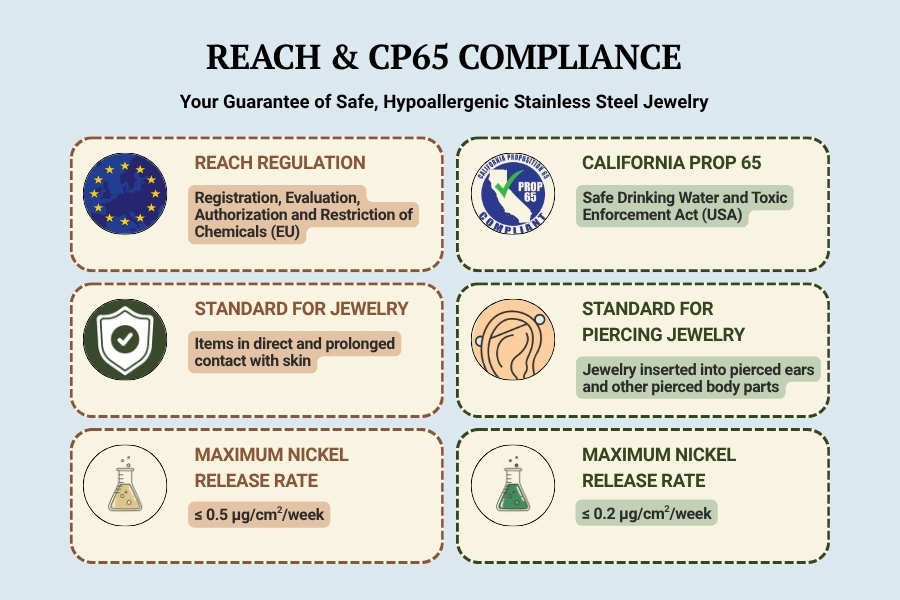
Under the REACH and California Prop 65 regulation, it’s stipulated that: a jewelry intended for prolonged skin contact must not exceed a release rate of 0.5 µg/cm2/week. Also, the maximum nickel release rate for jewelry inserted into pierced ears and other pierced parts of the human body must not exceed 0.2 µg/cm2/week.
This is to tell you that the focus isn’t on how much nickel is in jewelry, instead, it’s how much nickel is released. 316L stainless steel, for example, releases less than 0.1 µg/cm2/week, making it nickel-free and hypoallergenic. It’s ideal for piercings and prolonged wear.
Summary: Building Trust with Your Customers
Now that you have a clearer understanding of how stainless steel reacts with the skin and what nickel-free actually means, you can better communicate with your customers with confidence.
